

Multilingualism
Multilingualism
Multilingual education from an early age
Through the process of learning English and French, our students enjoy the experience of learning in each of their classes, which fosters motivation and commitment and, consequently, more effective learning. Our methodology is distinguished by:
- Creativity and a love of learning.
- Inclusion and differentiated teaching.
- A genuine concern for the emotional well-being of every student.
- A friendly, respectful and collaborative environment.

English
From Early Years to Primary
From their earliest years, students learn English in real-life, meaningful contexts. In The English Nursery and Early Years, they begin with everyday vocabulary, basic instructions and expressions linked to each subject area within the Inquiry Units, such as ‘Green Life’ (relating to plants, etc.).
In Primary, the focus broadens to encompass the four language skills: Speaking, listening, reading and writing. Through engaging activities, students develop academic vocabulary and communication skills that foster logical thinking and creativity.
Critical thinking in English
During the first years of Secondary, English becomes a tool for fostering creative thinking, as well as for developing critical and analytical thinking. Each unit (three per year) involves working with literary and non-literary texts, which enable students to develop in-depth analysis, creative writing (poems, short stories) and advanced reading comprehension. By the end of this stage, students achieve a B1 level in English according to the Common European Framework.
English as a tool for analysis and argumentation
In the final years of Secondary, Grades 10 and 11, students build on the analytical skills they acquired in previous years through more complex literary and non-literary texts (blogs, cartoons, articles, novels, plays, poetry, etc.), both in English and translated. Students respond to these texts through formal analytical essays, comparisons between texts, and individual oral analyses. Students demonstrate advanced language proficiency by reaching a C1 level in English by the end of the school year.
Testimonials

French
Getting started with French
French classes begin in Grade 4 at The English School, where students become familiar with the language, with a focus on speaking. By the end of the year, they are able to introduce themselves, identify objects in their surroundings, understand basic classroom instructions and talk about their preferences.
Comprehensive skills and intercultural awareness
In Grades 5 to 9, learning focuses on developing the four language skills—listening, speaking, reading and writing—with an emphasis on knowledge, respect and cultural understanding:
In Grades 5 and 6, students reach beginner level, learning the basics of phonetics and vowel combinations, as well as how to introduce themselves and their families, describe where they live and their interests, talk about French-speaking countries, and find their way around the city.
In Grades 7, 8 and 9, students reach a competent level, learning to present and analyse eating habits, describe and compare routines, describe future activities, appearance and personality, tell stories in the past tense, identify environmental issues, discuss the evolution of objects and understand the importance of responsible tourism.
French as a language for academic study
Students have the option to continue studying French as part of the Diploma Programme (DP) or the Career-related Programme (CP). French forms part of the Language Acquisition group and is designated as a ‘Language B’, focusing on achieving an advanced level and developing the four language skills (listening, speaking, reading and writing) over 6–7 hours per term. The programme aims to enable students to acquire the skills and intercultural understanding necessary to communicate successfully in a variety of real-life contexts, extending beyond the classroom and fostering awareness of and respect for cultural diversity.
Official DELF and DALF certificates
Our internationally accredited French programme enables students to obtain qualifications that certify their language proficiency:
Grade 8: DELF A1
Grade 9: DELF A2
Grade 10: DELF B1
Grade 11: DELF B2 – DALF C1
What sets us apart when it comes to teaching French?
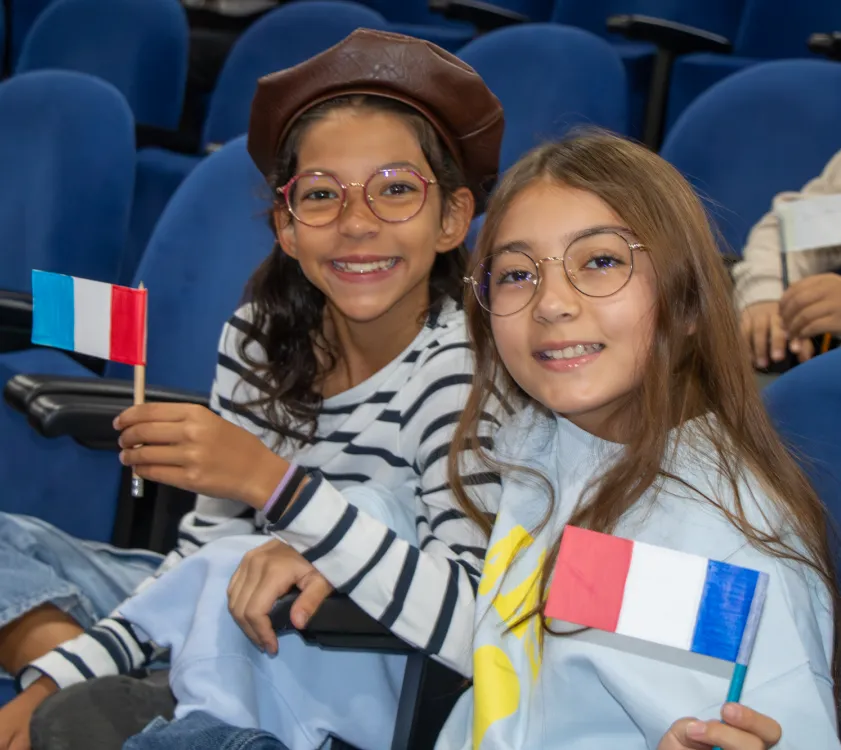
The English School is proud to be part of the French Educational Excellence Network (REF), working in partnership with the Alliance Française. We are one of 29 schools in Colombia accredited with the Francophone School Seal, having received our certification in the first round of applications in 2023. The French Department strives to promote differentiation and inclusion in the classroom, enabling students to progress in their learning at their own pace and according to their individual abilities, whilst providing comprehensive support.
Learning French beyond the classroom
We offer a range of activities designed to enhance French language learning in practical and enjoyable contexts:
- French club for students: Games, crafts, songs and videos.
- French club for teachers and staff.
- Academic support and remedial classes.
- Personalised tutoring (at an additional cost).
- Extracurricular intensive course (twice a week, sessions lasting 1 hour 20 minutes, at an additional cost).
- Immersion trip to the Alliance Française Organised with the aim of strengthening our students’ listening and speaking skills (Grades 10 and 11).
- Francophonie Celebration: An annual event featuring presentations, cultural activities and a showcase of talent through language.
At The English School, our focus on multilingualism goes beyond language teaching; it is a cultural immersion and a comprehensive preparation for the world. With an innovative curriculum and a wide variety of learning opportunities, both inside and outside the classroom, we ensure that our students not only master English and French but also develop a global mindset and communication skills that will set them apart in any academic or professional environment.
 Discover
  Admissions
  Learning
  Wellbeing